ISO Standards for UAE Businesses: The Complete Guide
ISO Certification With Iso Certification Abu Dhabi: A Practical Guide For Local BusinessesThe business environment of Abu Dhabi carries its own specific demands around ISO certification. It is shaped by the high number of government entities, big industrial players, and strict demands for tendering. For local firms who must navigate Certification for the first-time, understanding the practical realities specific to Abu Dhabi makes the process much easy and daunting.Government and Semi-Government Tenders Establish the Rules
The majority of Abu Dhabi's economic activity is conducted by big industrial players, all of which have formalized ISO certification as the prequalification standard for suppliers and contractors. This means the selection of ISO certification is frequently driven less by internal ambitions but rather by how practical contract a business is hoping to remain eligible for.
Industries and Energy Sectors Have Specific expectations
Abu Dhabi's manufacturing and energy sectors are characterized by extremely stringent expectations regarding safety and environmental management because of the sheer size and risk of operations in these sectors. Companies that are supplying to this sector as well as indirectly encounter that certification requirements from their clients directly are significantly higher than the minimum guidelines, reflecting the specific organizational culture for risk management.
Making a choice that's compatible with your actual business needs
An error that is often made early on is to try to obtain a certification just because an opponent has it, before determining if the standard is actually in line with the company's requirements and risk profile. The priorities of a logistics firm are totally different to those of a management company for facilities, and beginning with a clear assessment of what clients or tenders actually require is a way to avoid efforts later.
This Gap Assessment Stage Is to be taken seriously
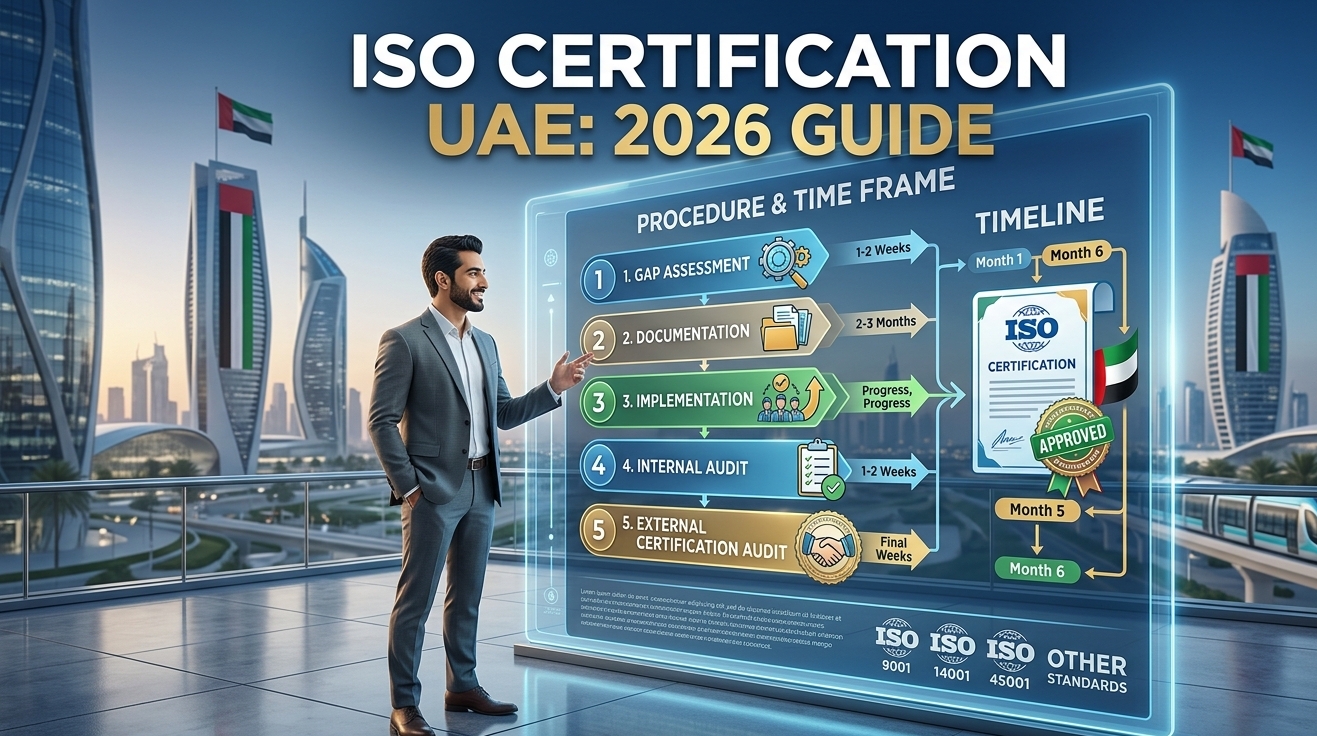
Before beginning formal implementation it is essential to conduct a gap-analysis against the relevant standard can reveal how well current practice meets the requirements and where genuine work is needed. By skipping or rushing this phase, it will result in a longer cost and costly implementation later on, because gaps that could have been identified early are instead discovered in the audit at the time of the audit.
Documentation Requirements are Much More Manageable Than They Sound
Many first-time applicants assume ISO documents will be overwhelming, but modern management system standards are less prescriptive in their approach to paperwork than older versions were, focusing instead on demonstrating that procedures are followed, and not just documented. A practical approach to documentation, based around what the business wants to monitor generally leads to a system that's actually used rather than one that's just for audit purposes.
The Options for Local Support Have Increased Significantly
Abu Dhabi now has a significantly larger pool of certification and consulting bodies with local expertise than even five years ago. This has lowered the necessity of relying solely on international companies with no on-the-ground background. The increase in localization has generally improved the speed of process and more responsive to particularities of operating in the Emirate.
Maintaining certification requires a continuous commitment.
Certification isn't a single achievement as it's a continuing commitment requiring regular surveillance audits that are usually annually, to check that the management system is maintained. Companies who view the initial certificate as a finish line instead of the point at which they began often struggle at further audits. Companies who integrate the standards into genuine daily practice experience much less difficulty recertification.
Free Zone businesses are faced with Particular Issues
Companies operating out of Abu Dhabi's numerous free zones often assume that certification requirements differ when compared to mainland businesses, but the global standards that underlie them are the same regardless of country. The only difference is the particular expectations for tenders and customers within each free zone's tenant system, which is worth clarifying directly with free zone officials or potential clients rather than accepting a blanket answer applies everywhere.
The Realistic Budgeting Process
Some first-time applicants budget only to cover the cost of external audit that is not taking into account the internal time investment, possible fees for consultants, as well as any operating changes required to bridge actual gaps that are discovered during the assessment. An effective budget accounts for the entire process from beginning to and issuance, not just that final invoice for audits, so you do not get caught off guard when the project is in its final stages.
Timing Certification based on Business Cycles
Companies with clear seasonal peak commonly found in construction as well as events-related sectors, often can schedule the more intensive processes of implementation and inspection in quieter times, rather than attempting to schedule certification projects in tandem with high operational demands. Abu Dhabi's certification bodies are typically flexible with their the timing of their projects, and increasing preferences earlier in the process tends to make the process more enjoyable for everyone affected.
Inspiring Businesses from Companies That Have So Far
Engaging directly with fellow Abu Dhabi businesses in a similar industry that have passed certification, often uncovers practical insights that any certification or consulting firm will divulge unprompted, from realistic timelines, to aspects of the audit tend to catch first-time applicants off to their feet. This type of insight from other businesses is incredibly valuable and should be researching before committing to a particular service or timeline.
Working With Government Liaison Requirements
businesses that want to obtain certification to be eligible for government tenders and government procurements Abu Dhabi should confirm exactly which certification scope as well as standard version a particular tender has and, as the requirements often refer to specific editions or additional local conditions that are beyond the base standard. Confirming this detail directly with the tendering authority prior getting started on the certification process minimizes the possibility of getting certification against a scope that is not the correct one.
for Abu Dhabi businesses approaching certification for the first time, the success usually depends on selecting an appropriate standard that is applicable to operation, focusing on the stages of preparation seriously, and applying certification as an management discipline, not something to tick off once and forget. Abu Dhabi businesses that approach certification with this level of preparedness, instead of looking at it as a rushed tender to rush through, will always come up with a better, more genuinely useful management system at the end of the process. This process doesn't have to be navigated alone, since Abu Dhabi's increasing number of expert local consultants and accreditation bodies guarantees that knowledgeable support is now more easily accessible than in the past. Benefiting from this growing local expert base makes the whole process much more manageable than it used to be. Take a look at the top rated ISO 45001 Certification for blog advice.
ISO 9001 Explained: Quality Management for UAE Companies
ISO 9001 remains the most commonly used management system in the world and for good reason. It's built on a useful concept, that a constant quality results from consistently well-managed processes and not from good intentions on their own. For UAE businesses that are looking to get certified, understanding what the standard actually is and what it requires helps to understand the procedure, which is often more complex than it is.What ISO 9001 Is Actually built around
At its core, ISO 9001 asks a business to define the key processes it uses and understand how they interact and monitor whether they're working, and improve them consistently in time. Instead of setting out the specific ways a company should conduct itself, it provides a framework to ensure that any approach one takes will be consistent and documented when required, and actually followed.
The reason UAE Businesses Want It?
Beyond its reputational value certification, a lot of UAE firms are seeking ISO 9001 because government and tenders in the private sector are increasingly listing it as prerequisite for prequalification. Beyond ticking that box companies that use the procedure correctly can reap efficiency benefits. This includes fewer repeat mistakes, better accountability and a more disciplined approach to dealing with customer complaints.
The role of top Management
One aspect that the standard is extremely clear on is real management involvement, as opposed to quality management being entrusted to only one compliance officer that is detached from the actual decision-making. Auditors are particularly looking for evidence that senior management is aware of and actively participates in the quality management process, instead of simply approving on it.
Risk-based thinking is the core of the Modern Standard
The current version ISO 9001 places considerable emphasis on identifying risks and opportunities relevant to an organization's specific circumstances, as opposed to applying a generic checklist regardless of the circumstances. This means a UAE construction firm and a UAE software company, though both certifying to the same standard, will end up with distinct quality management systems in line with their very different risks.
Customer Focus is present throughout the Standard
ISO 9001 repeatedly returns to the notion that quality implies meeting the needs of customers or expectations. This is not just internal efficiency indicators. The companies that implement the standard are required to have a proper system that can help customers understand what they require and ensuring that they are satisfied, instead of assuming internal quality inspections alone will provide the whole picture.
This Certification Process Itself
After implementing the appropriate processes and documentation, certification involves an external audit conducted in two stages. The first step is to review the documentation and readiness, then testing whether the system properly operating as described. The certification is followed by annual surveillance audits and a full review of recertification every 3 years to ensure regular compliance.
Common Misconceptions that are worth clearing up
A persistent misconception is that ISO 9001 requires enormous volumes of paperwork. In reality, the current version actually reduces the requirement for documentation significantly compared to earlier versions, with a focus on the demonstration of a genuine process control. Another myth is that certification guarantees product quality directly, when the truth is that it certifies an organization has a consistent system of governing quality, which is a distinct but still a valuable feature.
What is the different way to apply it across Different Sectors
Construction companies that have adopted ISO 9001 will focus heavily upon the processes of handover to projects and subcontractor administration, whereas a professional service company could be focused upon client engagement processes in addition to knowledge management. Its real-time flexibility across sectors is part of why it's still relevant over a vast array of UAE industries starting from manufacturing and moving to retail and consulting.
The Role of Continual Improvement
ISO 9001 doesn't treat quality as a single goal instead it's an ongoing process of evaluating performance, identifying opportunities to enhance, and implementing improvements in a systematic manner. Firms that truly believe in this continual improvement mindset, instead of viewing certification as a one-time project, are more likely to get lasting operating benefits from ISO 9001.
The importance of preparing your team for Cultural Shift
Perhaps the least understood aspect the process of ISO 9001 implementation is the genuine cultural shift required, making the shift from informal, independent methods of working towards more systematic, consistent procedures that don't depend on one person's memory or judgement. Prepare employees for this shift and educating them on the real benefits instead of just presenting it purely as a compliance exercise significantly improves the way implementation proceeds.
Why does the Investment Always be a Success?
Companies that adopt ISO 9001 thoughtfully, rather then merely using it as document-related exercise meant to satisfy any external requirement, typically observe that the investment pays off by reducing the number of errors that occur, clearer internal accountability, and a much stronger foundation for expansion as the enterprise grows. Benefits surpass the certification that it comes with.
When and how ISO 9001 Interacts With Customer Specific Complaints
The Norm requires that businesses create a real, well-organized procedure for dealing with customer complaints as well as feedback, taking each complainant as a point of data which can feed into an improvement process, instead of being ignored or resolved. UAE firms that develop an effective feedback loop discover that it is one of the most effective components of their overall management system, well beyond its role to meet the audit.
For UAE companies who are evaluating whether ISO 9001 is worth pursuing It usually comes down to whether the business truly desires more effective, standardized processes. because the certification itself is only a formal recognition for the underlying operation discipline. For UAE businesses who are determined to increasing their efficiency, rather than simply collecting a certificate, ISO 9001 offers a internationally recognized, tested framework to make the process permanent rather than just a random. The process does not require the elimination of what is working inside a company. ISO 9001 is fundamentally about the formalization and reinforcement of good practices rather than replacing it wholesale with something totally new. In this way, the certification is a natural extension of good management, not an external burden on the company. It is, at the end of the day an instrument built on basic principles that are consistently followed instead of anything mystical. That more than anything else is what makes it worthy of being considered with seriousness. Few other investments have such vast, long-lasting operational value. The time and effort that it takes. Take a look at the best ISO Certification Dubai for blog examples.