ISO Compliance in the UAE: How to Get It Right
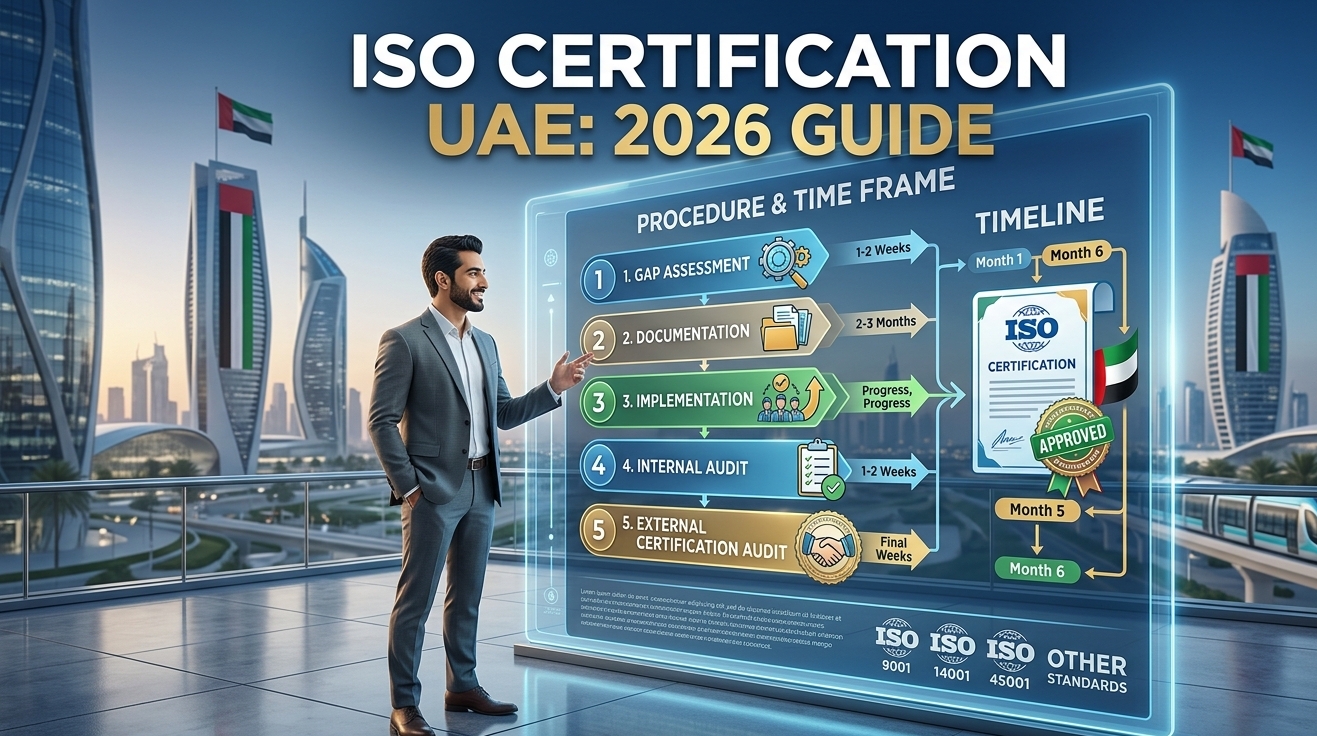
What's An Iso Consultant From The UAE Really Do?The term "ISO consultant" is a term that's used with a lot of ambiguity across the UAE market, and businesses approaching certification for the first time are often unsure what they're actually paying for when they hire one. Knowing the actual scope of the position helps set realistic expectations and makes it simpler to determine whether a consultant offers genuine value.Translating the ISO Standard into practical Business Terms
ISO standards can be written fairly formal, generalised languages that are designed to be applicable across many industries, which means a major part of a consultant's task is to translate the requirements to what they really mean for a specific company's daily processes. An experienced consultant will spend exploring how a particular business operates before suggesting how the current processes fit into the requirements of the standard.
Participating in the Initial Gap Assessment
Most work starts with a gap evaluation, comparing existing practices against the relevant requirements of the standard to determine the current practices, what is in need of adjusting, and what's not working. This assessment can affect the schedule and budget of the project, which is why an in-depth gap analysis that is honest and truthful more than the optimistic approach that overstates the effort involved.
Assisting in the development or refinement of the Management System Documentation
When gaps are discovered, consultants typically assist in developing or modify the written procedures, policies and documents required in order to demonstrate compliance. modern standards emphasise genuine respect for processes over paperwork volume. The most effective consultants fight against excessive documentation for the sake of documentation preferring a system that the business actually employs over one solely designed to satisfy an auditor's checklist.
Training personnel on the new or modified processes
Implementation of a system isn't merely a management exercise, as staff at every level need to know what's happening in their daily work routines and the reason for it. Consultants typically conduct seminars to create this understanding since a management structure that's just in paper but doesn't have real confidence can break down quickly once the initial certification pressure is gone.
Conducting Internal Audits Prior to the Actual Thing
All standards require at most an internal audit prior to the external certification audits take place And consultants frequently manage this directly or train personnel within the company to conduct this. This internal audit serves as an effective dry run, in which issues are discovered while there's time to tackle them, rather than discovering problems for the first time in front of an auditor external to the company.
Helping the Business through the External Audit
Although consultants aren't there on behalf in any certification process, due to the requirements for independence excellent consultants ensure that businesses are prepared thoroughly beforehand and are typically on hand to interpret as well as address any ambiguities that the auditor's report identifies.
What a Consultant Should Not Be Doing
A properly functioning consultant should never be the exact entity issuing the certificate itself since that arrangement undermines the independence that the whole system has to rely on. Any professional who is able to develop your management strategy and then certify it under the same umbrella is a real signal to be considered rather than a convenient shortcut.
Helping Interpret Standard Revisions and Updates
ISO standards are continually revised as well as a competent consultant will keep clients informed of any changes that are coming up before they become mandatory, allowing companies time to adjust rather than scrambling at last minute. This advisory function often is extended beyond an initial certification project particularly for companies that have a consultant hired on a periodic basis for supervision audit support.
How to adapt the approach to business Size
A reputable consultant will scale their approach in a way that is appropriate to the situation, whether it's a 5 person startup or a 5-hundred-person enterprise, as a management strategy that's appropriately proportional to business scale and complexity is much more likely to run effectively than one based on the requirements of a larger organization. Do not fall for a standard-fits-all approach which is used regardless of the firm's size.
In building internal capacity, not Just Dependency
The most experienced consultants will be able to leave a firm more self-sufficient as they found it. by educating employees in order to manage much of the system independently, rather than establishing an ongoing dependency solely for their own ongoing billing. The direct question to prospective consultants how they approach internal capacity development is an effective way to see if the consultant is genuinely focused on long-term client satisfaction.
A Timeline to Engage a Consultant
Companies often don't realize how early in the certification process a consultant should begin, often seeking out consultants only when the deadline is getting closer. Involving a consultant early enough to conduct a genuine gap assessment, rather than speeding up the implementation in response to pressure from time results in a much stronger, more sustainable management system as opposed to a rush, deadline-driven engagement.
Recognizing When You've Outgrown the need for a professional
Certain UAE firms, especially larger ones that have dedicated quality or compliance personnel are eventually at a stage where they can handle ongoing surveillance audits as well as standard transitions largely in-house, engaging consultants only for professional input. Recognizing this shift and not having to spend money on full consulting support, it reflects the development of a system of management that has genuinely become part of the way in which businesses operate.
A properly-understood ISO consultant from the UAE performs more than an agent for paperwork and more of an adjunct to the management team, helping guide the business through an operation shift instead of creating documents to meet an external requirement. Choosing the right consultant, and knowing precisely what their job description should and shouldn't include, will make the distinction between a project for certification that really improves how the business runs, as opposed to one that issues a certificate with any significant operational changes behind it. All of this doesn't make the work of a consultant any less valuable, however it is a reminder to businesses to take the partnership as a genuine partnership instead of transfer the entire responsibility to a different person. This mindset shift alone is likely to result in a more reliable and long-lasting certification. When approached this way, the certification process becomes a real expense rather than just another expense for compliance. This is an important distinction worth making sure to keep in mind during the course of. Follow the top ISO 22000 Certification for more examples.

ISO 9001 Explained: Quality Management for UAE Companies
ISO 9001 remains the most popular management system standard in the world which is not surprising since It is based on a practical concept, that is that quality results from consistently efficiently managed processes rather that good intentions on their own. For UAE companies who are thinking of obtaining certification, understanding what the standard actually needs can help clarify the process which often seems more complicated than it actually is.What ISO 9001 Is Actually Built On
Fundamentally, ISO 9001 asks a business to define its key processes and understand how they interact and monitor whether they're operating, and make improvements continuously as time passes. Rather than prescribing exactly how a business should operate in a specific way, ISO 9001 offers a framework for ensuring that whatever strategy you choose to take adheres to the same principles, is documented where appropriate, and fully followed.
The reason UAE Businesses Want to Get It?
Beyond the goodwill associated with Certification, a large number of UAE firms seek ISO 9001 because government and tenders from the private sector increasingly mention it as prerequisite for prequalification. Beyond ticking that box, businesses that implement the process correctly often reap real operating benefits, including less frequent mistakes, more transparent accountability and a more disciplined way of dealing with customer complaints.
The Role of Top Management
One area that the standard stands most steadfast about is genuine leadership involvement, not quality management being entrusted to a single compliance officer disconnected from actual decisions. Auditors will specifically look for evidence of senior leadership that understands and actively embraces the quality management system rather than simply signing off on it.
This is a key element of the Modern Standard
The current version of ISO 9001 places considerable emphasis on identifying opportunities and risks relevant to a specific company's environment, rather than implementing the same checklist in all circumstances. This means a UAE construction company as well as a UAE software firm, while both certified against the same standard in the end, will have distinctively different quality control systems reflecting their genuinely different risks.
Customer Focus Runs Throughout the Standard
ISO 9001 repeatedly returns to the idea that quality refers to meeting customer requirements for satisfaction, and not merely internal efficiency metrics. Businesses that comply with the standard are expected to establish a solid system for understanding what customers actually need and monitoring whether they're satisfied, instead of assuming internal quality tests alone can provide the full picture.
Its Certification Process Itself
After the implementation of the required processes and documents, certification involves an audit by an outside party that takes two stages. First, it is a review of documentation and readiness, before checking if the system is really operating as specified. The certification process is followed by annual checks of surveillance, as well as a review of recertification every three years to verify continued conformity.
Common Misconceptions that are worth clearing up
One of the most frequent misconceptions is that ISO 9001 requires enormous volumes of paperwork. The new version has actually decreased the need for documents significantly when compared to previous versions, focusing instead on demonstrating genuine process control. Another misperception is that certification guarantees it is a guarantee of quality for the product, however in fact it confirms that companies have a consistent management system to manage quality, and is a fundamentally different but still important.
How It Applies Differently Across Sectors
An construction company who has implemented ISO 9001 will focus heavily on processes for handover of projects and subcontractor management. While a professional service company could be focused more on processes for engaging clients as well as knowledge management. The standard's genuine flexibility in a variety of sectors is why it's relevant in a wide range of UAE industries in all aspects, from manufacturing to retail and consulting.
The Importance of Continuous Improvement
ISO 9001 doesn't treat quality as a set destination, however it's a constant process of evaluating results, identifying ways to improve, and then implementing changes gradually. The companies that truly embrace this continuous improvement philosophy, rather than seeing certification as a singular event, are more likely to get more long-term, meaningful operations benefits from the standard.
Making Your Team Ready to handle the Cultural Shift
Perhaps the least understood aspect from ISO 9001 implementation is the true cultural shift required transitioning away from informal, dependent methods of working to more organized, consistent procedures that do not rely on one person's memory or judgment. The preparation of staff members for this shift and communicating the advantages, rather than making it appear solely as an exercise in compliance significantly improves the way implementation runs.
What is the reason why an investment will be a Success?
Companies that adopt ISO 9001 thoughtfully, rather than merely an administrative exercise to meet an external demand, usually find the investment pays off by reducing the number of errors that occur, clearer internal accountability, and an extremely solid foundation for scalability as the company grows. The benefits transcend the requirements of the certificate as a whole.
What is the way that ISO 9001 Interacts With Customer Concerns In Specific
The Standard requires businesses to implement a legitimate, well-organized process for handling complaints from customers and feedback. The standard requires businesses to view each complainant as a point of data which should be used to inform improved processes instead of being ignored or resolved. UAE companies that are able to create this feedback loop in a proper manner often find it becomes one of the most efficient components of the overall management system far beyond its function to meet the audit.
For UAE companies looking to determine if ISO 9001 is worth pursuing it is a matter of fact that boils down to if the business really needs more stable, well-controlled processes since the certification itself actually a formal confirmation of the fundamental operational discipline. For UAE businesses that are truly dedicated to improvement in their processes instead of simply getting an accreditation, ISO 9001 offers a globally recognized and tested framework to make the process gradual rather than haphazard. The process does not require the elimination of what is already in place within a company, since ISO 9001 is fundamentally about consolidating and establishing good practice rather than replacing it wholesale with something that is completely different. If it is approached this way the certification can be seen as a natural extension of good management rather than an external burden imposed on the business. It is, at the end of the day a framework that is built around practicality and consistency instead of being a mystery. That over all else, is what gives it genuine consideration. Few investments provide this large, long-lasting value. Incredibly worth the effort it takes to figure out. See the top rated ISO Certification Dubai for website info.